


Files
Download Full Text (218 KB)
Keywords
patient, family, education, intervention, CLABSI, Central Line-Associated Bloodstream Infection
Disciplines
Nursing
Description
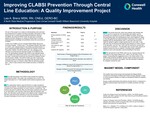
The aim of this project is to create an interdisciplinary team and lead the development of a patient and family education intervention to help reduce the risk of central line-associated bloodstream infections (CLABSIs). By using the PDSA model, the goal was to educate patients and their caregivers on caring for central lines to increase patient/caregiver knowledge and potentially reduce the occurrence of CLABSIs.
In 2024, the CLABSI count for Corewell Health William Beaumont University Hospital –6 North was 2. The standard infection ratio (SIR) is a metric used, adjusted based on the facility and patient factors, to track hospital-associated infections (Centers for Disease Control and Prevention, 2024a). The SIR for 2024 was 1.06, indicating more infections occurred than the expected number of CLABSIs for this unit. The standardized utilization ratio (SUR) is also adjusted based on the facility and location-level factors, but it tracks device use, so, in this case, it would track central line use (Centers for Disease Control and Prevention, 2024b). The SUR for 2024 was 0.89, meaning the expected number of central lines was higher than the actual number of central lines seen on 6 North in 2024. With the SIR being greater than 1, there is clear evidence that CLABSI prevention is needed on this unit.
Publication Date
5-6-2026
Recommended Citation
Brenz LA. Improving clabsi prevention through central line education: a quality improvement project. Presented at Corewell Health William Beaumont University Hospital; 2026 May 6-12; Royal Oak, MI.