


Files
Download Full Text (337 KB)
Keywords
Thirst, critically ill, intensive care unit
Disciplines
Nursing
Description
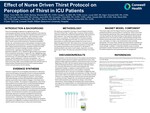
Thirst is increasingly recognized as a significant yet often underassessed symptom among critically ill patients in the intensive care unit (ICU). Observational research indicates that thirst occurs in approximately 70–76% of ICU patients, with moderate to severe intensity levels commonly reported, making it one of the most prevalent discomforts experienced during critical illness (Negro, 2021). Factors such as fluid restrictions, mechanical ventilation, diuretic use, and limited access to oral hydration contribute to both the development and persistence of thirst in this population (Negro, 2021). Beyond physical discomfort, qualitative studies show that untreated thirst can lead to feelings of anxiety, distress, and powerlessness, negatively impacting patients’ overall ICU experience (Kjeldsen, 2017). Despite its high prevalence and impact, thirst is frequently overlooked in routine ICU care, highlighting a gap in symptom management (Negro, 2021). Emerging evidence suggests that structured, non-pharmacological interventions—such as oral cooling, menthol application, and early oral hydration—can significantly reduce both thirst intensity and distress compared to usual care (Liang, 2025). These findings support the potential value of implementing a standardized thirst protocol to improve patient comfort and outcomes in the ICU setting.
Publication Date
5-6-2026
Recommended Citation
Beerer T, Berisha M, Cangemi I, Curran L, Elgert N, Frenchak N et al [Hendee J, Konopitski C, Lafata D, Rofa R, Rogers CR, Watkins K]. Effect of nurse driven thirst protocol on perception of thirst in icu patients. Presented at Corewell Health William Beaumont University Hospital; 2026 May 6-12; Royal Oak, MI.
Comments
Nurses Week at Corewell Health William Beaumont University Hospital, Royal Oak, MI, May 6-12, 2026.