


Files
Download Full Text (453 KB)
Description
Although the demographic composition of medical students and graduate medical trainees has become increasingly diverse, leadership positions and markers of professional distinction have historically lagged in comprehensive representation. Prior literature suggests that women and underrepresented racial and ethnic groups experience progressive attrition at higher levels of professional advancement in plastic surgery such as conference presentation acceptances, fellowship applicants, and institutional division leadership. In this project, we aim to examine whether these disparities persist across national academic leadership roles within craniofacial plastic surgery and how they have evolved over time.
Leadership positions were examined from 2016-2025 and stratified into three tiers by selectivity (tier 1 being most selective and tier 3 being least). Tier 1 consisted of craniofacial journal editors-in-chief and national professional society presidents. Tier 2 consisted of professional award and research grant award recipients. Tier 3 consisted of journal editorial board and professional society board positions. Race and gender were recorded for craniofacial plastic surgeons in each role using institutional biographies stating race and/or gender/pronouns, name origins, and accompanying online images. Where no information was available or ambiguous, the "Unknown" race and gender designations were used. Racial and gender distributions were compared using chi-square and Fisher's exact tests within and between early (2016-2020) and late (2021-2025) time periods within tiers with significance for p-values less than 0.05.
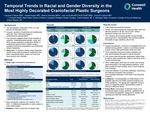
Over all tiers, 83.6% of leadership positions were held by men, 16.4% by women, and 0% by transgender, non-binary, and other gender groups. Positions were filled by White surgeons in 57.2% of cases, 30.0% Asian, 6.0% Middle Eastern or North African, 4.1% Hispanic/Latinx, 1.7% African American/Black, and 1.0% combined for Unknown Race, Other Race, American Indian or Alaskan Native, and Hawaiian Native or Pacific Islander. Gender and race imbalances (compared to male and White) were observed in both early and late time periods for all tiers (all p< 0.001). Pairwise comparisons demonstrated persistent underrepresentation of gender and racial/ethnic minorities across time periods in all tiers (p>0.05 for change over time).
Despite increasing diversity in the medical training pipeline, the most highly decorated positions in craniofacial plastic surgery remain disproportionately occupied by White male surgeons. These disparities persist across levels of selectivity and time, suggesting that gains in trainee diversity have not yet translated into equivalent representation in roles of power and recognition within the specialty. Continued attention to promotion pathways, mentorship, and selection processes may promote a more equitable distribution in the field's most influential positions.
Publication Date
5-8-2026
Disciplines
Plastic Surgery
Recommended Citation
Baker CE, Ayesh A, Hamdan S, Girotta JA, Carlson AR. Temporal trends in racial and gender diversity in the most highly decorated craniofacial plastic surgeons. Presented at: Research Day Corewell Health West; 2026 May 8; Grand Rapids, MI.
Comments
2026 Research Day Corewell Health West, Grand Rapids, MI, May 8, 2026. Abstract 2111