


Files
Download Full Text (222 KB)
Description
Recent decades have witnessed substantial shifts in the plastic surgery (PS) residency model. Through the 1990s, PS training required 5 years in general surgery followed by 2-3 years in fellowship-the independent route. In 1995, the integrated model, a direct 6-year pathway into PS, gained legitimacy from the American Board of Plastic Surgery, and American Council for Graduate Medical Education (ACGME) accreditation followed in 2012. In this project, we aim to characterize trends in plastic surgery residency by training model and evaluate relationships between structural, geographic, and economic factors and training capacity from 2010-2025.
This is a cross-sectional observational study. PS residency quotas were obtained from the National Residency Matching Program (NRMP) yearly match reports (integrated programs) and the San Franscisco Match (independent) from 2010-2025. Institutional factors analyzed were training models offered (NRMP), initial accreditation year (ACGME), sponsorship type, state and U.S. region, urbanicity (2023 Rural-Urban Continuum Codes), number of programs in the state, state graduate medical education per capita (2023 AAMC State Physician Workforce Data Report), and state percentage of private insurance holders and median income (2023 U.S. Census data). Sources are listed or publicly available information. Univariate analysis was conducted via Kruskal-Wallis and Spearman tests. Multivariable linear regression was used to identify independent factors associated with annual capacity change with significance at p< 0.05.
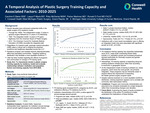
From 2010-2025, PS residency capacity increased by 20.3% (107 positions). In 2010, there were 73 institutions offering 73 integrated and 93 independent spots. In 2025, there were 104 institutions offering 221 integrated spots and 52 independent. Over the time period, there were 72 newly accredited programs and 34 dissolutions. Institutions were most likely to offer both independent and integrated programs (45.5%), be private (52.7%), and be located in large metropolitan areas (median RUCC: 1.0 [IQR 1.0-2.0]) in the South (34.5%). Institutions offering an integrated training model only were associated with program expansion (p=0.046). No other structural, geographic, or state-level economic factor was independently associated with growth in whole-group or subgroup analysis by program type (all p>0.05).
PS residency training capacity has expanded substantially since 2010. Large-scale contributing factors likely include U.S. population growth and increased procedural demand particularly for minimally invasive and gender affirming procedures. Interestingly, PS training capacity appears to be expanding along the existing academic infrastructure rather than according to economic or geographical factors. Thus, despite national emphasis on equitable workforce distribution, training expansion appears not to correlate with commonly cited need-based metrics.
Publication Date
5-8-2026
Disciplines
Plastic Surgery
Recommended Citation
Baker CE, Marla LP, McDaniel R, Martinez P, Ford RD. A temporal analysis of plastic surgery training capacity and associated factors: 2010-2025. Presented at: Research Day Corewell Health West; 2026 May 8; Grand Rapids, MI.
Comments
2026 Research Day Corewell Health West, Grand Rapids, MI, May 8, 2026. Abstract 2084