


Files
Download Full Text (244 KB)
Description
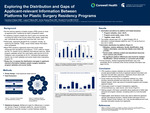
As plastic surgery grows tremendously as a field, so does its applicant pool, sustaining the specialty's highly competitive match. Historically, applicants have been able to virtually gauge fit for a residency program by exploring its website. Today, social media makes information even more accessible. We aimed to assess the distribution and remaining gaps in applicant-relevant information between plastic surgery residency program websites and social media to provide a holistic picture of program information transparency.
This is a cross-sectional observational study examining plastic surgery residency program websites and social media (Instagram and Facebook) accounts across nine informational domains: program mission, educational resources, curriculum, resident identification, faculty identification, clinical workload (e.g. duty hours, case volume), wellness initiatives, away rotations, and interviews. Jaccard similarity coefficients were used to quantify the overlap in content between the two platforms, and McNemar's tests were performed to assess the differences in content per domain.
A total of 130 plastic surgery residency programs were analyzed (91 integrated, 39 independent). A mean of 46.5% of information was available on program websites, 37.0% on social media, and 64.5% combined (median Jaccard: 0.29). Across domains, resident information was most accessible (94.0% combined) while clinical workload was least prevalent (18.0%). Whereas faculty information, mission statement, and interview details were more likely to appear on program websites, wellness content and program resources were significantly more common on social media (all p< 0.001). No significant platform differences were found for resident information, clinical workload, or curriculum (all p>0.05).
Together, plastic surgery residency program websites and social media provide approximately two-thirds of applicant-relevant information and less than half alone. Social media was much more likely to emphasize wellness (e.g. team bonding, personal activities) and resources (e.g. simulation labs, educational facilities), which may serve to humanize programs and increase applicant interest. However, critical gaps remain in transparency particularly regarding clinical workload. Making program information accessible allows applicants to better align their priorities with
Publication Date
5-8-2026
Disciplines
Plastic Surgery
Recommended Citation
Baker C, Marla L, Hoang-Pham A, Ford R. Exploring the distribution and gaps of applicant-relevant information between platforms for plastic surgery residency programs. Presented at: Research Day Corewell Health West; 2026 May 8; Grand Rapids, MI.
Comments
2026 Research Day Corewell Health West, Grand Rapids, MI, May 8, 2026. Abstract 2127