


Files
Download Full Text (363 KB)
Description
'Cepacia syndrome' is a rare clinical presentation of Burkholderia cepacia complex (BCC) infection with a mortality rate of 50%, manifesting as a necrotizing pneumonia progressing to septicemia and multiorgan dysfunction. Burkholderia cepacia complex encompasses a group of opportunistic gram-negative bacteria that most commonly affect patients with cystic fibrosis or chronic granulomatous disease. The airways of cystic fibrosis patients typically represent an evolving ecosystem forming a clonal population of any combination of Burkholderia species. BCC have an inherently very mutable genome and exhibit multiple drug resistance mechanisms. This coupled with variable drug resistance profiles make treatment of Burkholderia infection a very challenging clinical problem. The purpose of this investigation is to expose the lack of evidence on treatment options for Burkholderia infection.
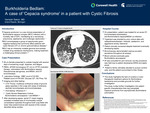
I present a case of a 56 y/o female with PMHx of ΔF508 homozygous cystic fibrosis not on CFTR modulator therapy, colonization with Burkholderia cepacia, Pseudomonas aeruginosa, and MSSA, and CF-bronchiectasis who presented to outside hospital with several days of worsening cough, dyspnea, and fatigue. Initial evaluation revealed a WBC count of 32,000, platelet count of 476,000, glucose 327, and Alk Phos 155. CTA thorax showed multifocal confluence areas of ground-glass opacities in the lungs with areas of extensive perihilar bronchiectasis and bronchiolectasis. Viral testing returned positive for Influenza A. A cystic fibrosis respiratory culture demonstrated infection with Burkoholderia cenocepacia and MSSA. After patient developed sepsis in the hospital, serial CT chest imaging revealed significantly increased size and number of innumerable nodular consolidative opacities throughout both lung fields with lower lobe predominance with several of the nodular densities being cavitary.
Overall, this study highlights the lack of curative or even therapeutic treatment options for Burkholderia bacteremia and provides grounds for further investigation. Additionally, this study invites further investigation into patient specific characteristics such as viral infection, long-term central venous access, and lack of disease modifying therapy that may precipitate cepacia syndrome from asymptomatic Burkholderia colonization. Identifying risk factors for the development of cepacia syndrome may allow for more aggressive treatment of predisposed patients.
Publication Date
5-8-2026
Disciplines
Internal Medicine
Recommended Citation
Satoor R. Burkholderia Bedlam: A case of 'Cepacia syndrome' in a patient with Cystic Fibrosis. Presented at: Research Day Corewell Health West; 2026 May 8; Grand Rapids, MI.
Comments
2026 Research Day Corewell Health West, Grand Rapids, MI, May 8, 2026. Abstract 2132