


Files
Download Full Text (435 KB)
Description
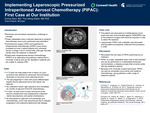
Peritoneal carcinomatosis represents a challenge to manage. These metastases have a reduced response to systemic chemotherapy due to poor peritoneal vascularization [1]. Cytoreductive surgery (CRS) and hyperthermic intraperitoneal chemotherapy (HIPEC) have shown increased survival in select patients with colorectal cancer in phase 2 and 3 clinical trials, although has best results when R0 resection is obtained [2]. Pressurized intraperitoneal aerosol chemotherapy (PIPAC) is an alternative drug delivery method that is minimally invasive and can be repeated in patients who are unable to undergo CRS [1].
A 72 year-old male patient with a history of Lynch syndrome was referred for peritoneal carcinomatosis secondary to recurrent colon adenocarcinoma. He was diagnosed in 2022 with poorly differentiated hepatic flexure adenocarcinoma with signet ring features.
We present the first case of PIPAC performed at our institution. PIPAC is a safe, repeatable option that is well tolerated and can be performed on unresectable peritoneal carcinomatosis, a disease process that currently exists with few treatment options2. Because of its minimally invasive technique, PIPAC can also be completed concurrently with systemic chemotherapy, giving patients a wider range of treatment options [1].
Publication Date
5-8-2026
Recommended Citation
Sand E, Wong-Gillam T. Implementing laparoscopic pressurized intraperitoneal aerosol chemotherapy (PIPAC): First case at our institution. Presented at: Research Day Corewell Health West; 2026 May 8; Grand Rapids, MI.
Comments
2026 Research Day Corewell Health West, Grand Rapids, MI, May 8, 2026. Abstract 2073