


Files
Download Full Text (498 KB)
Description
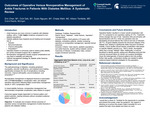
Ankle fractures present as significant clinical challenges to diabetic populations, with fracture rates increased 1.24 fold in diabetic patients compared to nondiabetic patients. Additionally, there are substantially more soft tissue complications and delayed bone healing following ankle fractures, resulting in increased risks of nonunion, wounds, Charcot arthropathy, and amputation. While operative fixation is often recommended to restore ankle stability, some sources outline surgical and postoperative risks, and suggest a higher complication rate in diabetic patients treated with surgical treatment compared to conservative management. Due to these concerns, the optimal treatment strategy for diabetic ankle fractures remains elusive. This systematic review aims to evaluate and compare clinical outcomes of surgical versus nonsurgical management of diabetic ankle fractures.
A systematic review was conducted in accordance with PRISMA guidelines. A comprehensive literature search of PubMed Library databases was performed to identify studies evaluating ankle fractures in ambulatory, adult patients (≥18 years) with diabetes mellitus. Search terms included "diabetes", "ankle fracture", "operative", "nonoperative". Studies comparing surgical and/or nonsurgical management of ankle fractures in diabetic patients and reporting clinical outcomes were included. Case reports, pediatric studies, studies focused solely on healthy patient populations, and studies focused on non-ankle fractures were omitted. Outcomes of interest included complication rates, need for revision surgery, and functional outcomes. Study quality for retrospective chart review studies were assessed using the Newcastle-Ottawa Scale.
The literature search identified two comparative studies consisting of 101 ambulatory, diabetic adult patients (≥18 years) with ankle fractures. The complication rates however varied by treatment approach and patient selection. In a cohort involving closed, displaced diabetic ankle fractures (n = 28), nonoperative treatment was associated with 21 fold complication rates when compared to operative treatment (75% vs 12.5%, OR 21.0, P = .004). Complications included loss of reduction/malunion, new-onset Charcot arthropathy, cast ulcer, unplanned operation, and deep infection. Additionally, delayed surgery after failed nonoperative treatment led to 100% complication rates compared to 12.5% with immediate ORIF (p = 0.005). In a separate cohort of closed, mixed-stability diabetic ankle fractures (n = 73), the study primarily evaluated early protected weightbearing protocol. Complications were low, with 2 in the nonoperative group (n = 25) and 12 in the operative group (n = 48), most commonly wound dehiscence (18.8%).
Diabetic patients with ankle fractures experience elevated risks regardless of treatment modality, yet evidence guiding optimal management remains limited. Available comparative data suggest improved outcomes with operative fixation in displaced fractures, while outcomes appear similar between operative and nonoperative approaches in selected mixed-stability fractures. Given the heterogeneity of fracture patterns and risk profiles, further high-quality, comparative studies are needed to define evidence-based treatment strategies for this high-risk population.
Publication Date
5-8-2026
Disciplines
Orthopedics
Recommended Citation
Chen E, Wahl C, Ovik D, Tenfelde A. Outcomes of operative versus nonoperative management of ankle fractures in patients with diabetes mellitus: A systematic review. Presented at: Research Day Corewell Health West; 2026 May 8; Grand Rapids, MI.
Comments
2026 Research Day Corewell Health West, Grand Rapids, MI, May 8, 2026. Abstract 2137