


Files
Download Full Text (363 KB)
Description
Esophageal atresia (EA) is a congenital disorder that results in discontinuity of the esophagus, with an estimated global incidence of approximately 3 in 10,000 live births. The most common surgical intervention is primary anastomosis of the proximal and distal segments of the esophagus. However, there are situations when primary anastomosis is not possible due to a long gap between the proximal and distal esophageal segments. One surgical solution for these cases is esophageal replacement with other portions of the gastrointestinal tract, such as the stomach, jejunum, or colon. We present a case of a late complication in an adult patient with a history of esophageal atresia, who previously underwent surgical repair with colonic interposition.
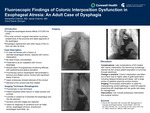
The patient is a 41-year-old with a history of neonatal EA repaired with colonic interposition, who presented to an outpatient gastroenterology clinic with chronic dysphagia. The patient reported several years of progressively worsening difficulty with swallowing and globus sensation. An esophagram was ordered to investigate the shape of the patient's esophagus/colonic conduit and to evaluate for potential narrowings or dysmotility. Fluoroscopic esophagram with barium contrast demonstrated a tortuous and dilated colonic conduit with significant stasis of barium.
Late complications of EA treated with colonic interposition are becoming increasingly relevant as this unique patient population is surviving through adulthood. Colonic interposition has fallen out of favor due to higher rates of graft dysfunction, including delayed emptying and stasis, with a large portion of patients requiring conduit revision. Fluoroscopic examination is useful for characterizing conduit pathology in adult EA patients presenting with dysphagia and can guide next steps for management, including endoscopic intervention versus surgical revision.
Publication Date
5-8-2026
Recommended Citation
Charron A. Fluoroscopic findings of colonic interposition dysfunction in esophageal atresia: An adult case of dysphagia. Presented at: Research Day Corewell Health West; 2026 May 8; Grand Rapids, MI.
Comments
2026 Research Day Corewell Health West, Grand Rapids, MI, May 8, 2026. Abstract 2010