


Files
Download Full Text (636 KB)
Description
Measles is a highly contagious viral illness marked by classic symptoms of fever, rash, cough, coryza, and conjunctivitis. Measles rash typically presents 10-14 days after exposure. The best known protection against measles is the measles, mumps, and rubella vaccine. Current guidelines recommend administering IGIM 0.5ml/kg within six days of measles exposure. Additionally, guidelines for exposed persons who received postexposure prophylaxis with IGIM recommend 28 days of quarantine after last exposure. Our case presents the unique challenge of when PCR testing should be utilized in asymptomatic infants born to mothers with known measles exposure as guidelines for testing are largely based on development of the classic rash.
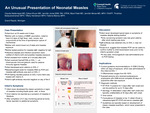
Patient was born at 35 weeks and 4-day gestational age to a G2P2 mother in her 20s via vaginal delivery. Mother had no history of MMR vaccination and received her prenatal care through a lay midwife. At the time of spontaneous rupture of membranes, she was noted to have 5 days of high fever and 4 days of rash, coryza, and conjunctivitis. Mother had recently traveled out of state with probable measles exposure. The infant was given GamaSTAN, an intramuscular immune globulin used for passive immunity against measles, on day of life (DOL) 1. Infant developed groin edema on DOL 2, which worsened from morning to evening. The swelling started at the penis and spread to the pubic area. On DOL 3, nasopharyngeal swab for measles RNA by PCR was sent to the state public health laboratory for testing. The infant was isolated from mother until DOL 4. On DOL 4, PCR testing returned positive for measles and the infant was started on vitamin A, 50 000 units per day for 2 days.
In this case, mother had confirmed exposure to measles at the time of delivery and the infant did not develop typical symptoms of expected measles infection. This does raise the question of when and via which method screening should be pursued. There are several ways to diagnose measles, including RT-PCR, serology, and viral culture. Interestingly, the guidelines for testing currently involve development of the classic measles exanthem, however, in our case, the infant never developed the typical rash. Instead, the only atypical symptom was groin edema.
Publication Date
5-8-2026
Disciplines
Pediatrics
Recommended Citation
Nadernejad C, Khuon D, Jones J, Patel M, Morse J, Balasubramanian T, Henderson T, Mamou F. An unusual presentation of neonatal measles. Presented at: Research Day Corewell Health West; 2026 May 8; Grand Rapids, MI.
Comments
2026 Research Day Corewell Health West, Grand Rapids, MI, May 8, 2026. Abstract 2056