


Files
Download Full Text (3.4 MB)
Description
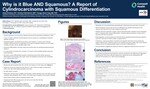
Cylindrocarcinoma is an uncommon adnexal carcinoma first described by Wieldman in 1929. It does not harbor distinctive clinical features and can present as a manifestation of Brooke-Spiegler syndrome. Histopathologically, cylindrocarcinoma shares some features in common with its benign analogue (cylindroma) but is recognizable on the basis of malignant features such as nuclear crowding, necrosis, and an elevated mitotic index. Historically, the immunophenotype associated with cylindrocarcinoma has been nonspecific, but SOX10 expression can now be used as a tool to distinguish the spiradenocylindrocarcoma spectrum (and also transformed adenoid cystic carcinoma) from other basaloid carcinomas. Squamous differentiation has been rarely documented within the spiradenocylindrocarcinoma spectrum. In the series of Granter et al. (2000), however, 2/12 tumors (16%) exhibited partially squamous histomorphology. We report a poorly differentiated example of cylindrocarcinoma with marked squamous differentiation that mimicked other types of basaloid carcinoma with cornification, in particular matrical carcinoma. A specific diagnosis was possible on the basis of conventional microscopic features and SOX10 immunopositivity. The literature and differential diagnosis of keratinizing basaloid carcinomas will be reviewed.
Publication Date
10-7-2023
Keywords
cylindrocarcinoma, squamous differentiation, differential diagnosis
Disciplines
Pathology
Recommended Citation
Schukow C, McCalmont TH. Yang HH. Why is it blue and squamous? A report of cylindrocarcinoma with squamous differentiation. Presented at: American Society for Dermatopathology 60th Annual Meeting; 2023 Oct 7; Chicago, IL. Available from:https://proceedings.asdp.org/index.cfm/item/29456
Comments
American Society for Dermatopathology 60th Annual Meeting, October 5-8, 2023, Chicago, IL