






-
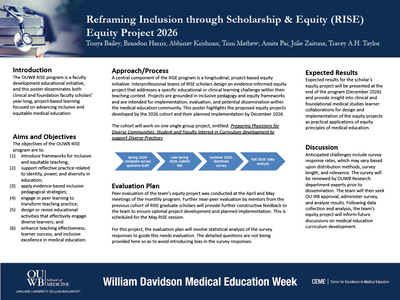
Reframing Inclusion through Scholarship & Equity (RISE) Equity Project 2026
Tonya Bailey, Brandon Harris, Abhinav Krishnan, Trini Mathew, Amita Pai, Julie Zaituna, and Tracey Taylor
Publication Date: 5-7-2026
The OUWB RISE program is a faculty development educational initiative, and this poster disseminates both clinical and foundation faculty scholars’ year-long, project-based learning focused on advancing inclusive and equitable medical education.
-
Kern National Network at OUWB: Helping Medical Student Ideas Come to Life While Promoting Student Wellness and Academic Success
Shivapriya Chandu, Ahmad Abu-Mahfouz, Rohit Ray, Riya Chhabra, and Berkley Browne-Holtz
Publication Date: 5-7-2026
Poster Winner - Medical students experience evolving stressors and wellness needs throughout training. From preclinical coursework to board preparation and clinical rotations, priorities may shift over time. This project addresses the following research question: How can we effectively improve student wellness initiatives through student engagement during the M1- M3 medical school years?
-
Not All Health Problems are Medical
Lisa George, Jennifer Hartke, Linda Caurdy-Bess, and Karen Glorio
Publication Date: 5-7-2026
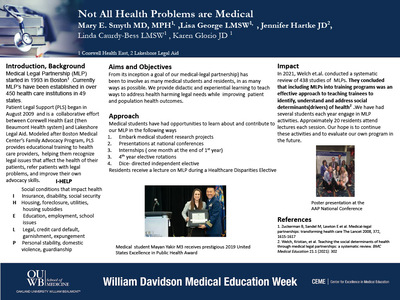
Medical Legal Partnership (MLP) started in 1993 in Boston. Currently MLP’s have been established in over 450 health care institutions in 49 states. Patient Legal Support (PLS) began in August 2009 and is a collaborative effort between Corewell Health East (then Beaumont Health system) and Lakeshore Legal Aid. Modeled after Boston Medical Center’s Family Advocacy Program, PLS provides educational training to health care providers, helping them recognize legal issues that affect the health of their patients, refer patients with legal problems, and improve their own advocacy skills.
-
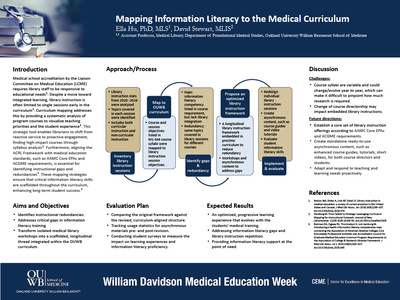
Mapping Information Literary to the Medical Curriculum
Ella Hu and David Stewart
Publication Date: 5-7-2026
Medical school accreditation by the Liaison Committee on Medical Education (LCME) requires library staff to be responsive to educational needs. Despite a move toward integrated learning, library instruction is often limited to single sessions early in the curriculum. Curriculum mapping addresses this by providing a systematic analysis of program courses to visualize teaching priorities and the student experience. This strategic tool enables librarians to shift from reactive service to proactive engagement, finding high-impact courses through syllabus analysis. Furthermore, aligning the ACRL Framework with medical education standards, such as AAMC Core EPAs and ACGME requirements, is essential for identifying instructional gaps and redundancies. These mapping strategies ensure that critical information literacy skills are scaffolded throughout the curriculum, enhancing long-term student success.
-

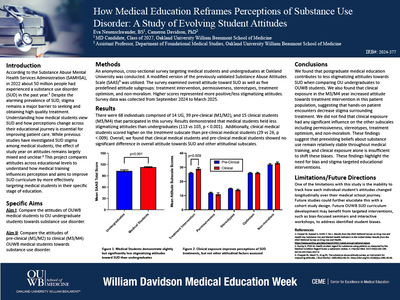
How Medical Education Reframes Perceptions of Substance Use Disorder: A Study of Evolving Student Attitudes
Eva Neueunschwander and Cameron Davidson
Publication Date: 5-7-2026
According to the Substance Abuse Mental Health Services Administration (SAMHSA), in 2022 about 50 million people had experienced a substance use disorder (SUD) in the past year.1 Despite the alarming prevalence of SUD, stigma remains a major barrier to seeking and obtaining high quality treatment. Understanding how medical students view SUD and how perceptions change across their educational journey is essential for improving patient care. While previous studies have investigated SUD stigma among medical students, the effect of study year on attitudes remains largely mixed and unclear.2 This project compares attitudes across educational levels to understand how medical training influences perception and aims to improve SUD curriculum by more effectively targeting medical students in their specific stage of education.
-
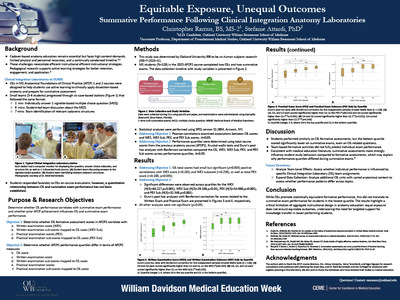
Equitable Exposure, Unequal Outcomes Summative Performance Following Clinical Integration Anatomy Laboratories
Christopher Ramus and Stefanie Attardi
Publication Date: 5-7-2026
Cadaver-based anatomy education remains essential but faces high content demands, limited physical and personnel resources, and a continually condensed timeline. These challenges necessitate efficient instructional efficient instructional strategies. Pedagogical research supports active learning strategies for better retention, engagement, and application.
-
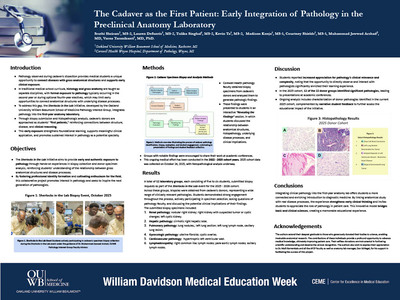
The Cadaver as the First Patient: Early Integration of Pathology in the Preclinical Anatomy Laboratory
Sruthi Shriram, Lauren DeSantis, Tulika Singhal, Kevin Ta, Courtney Shields, Muhammad Jawwad Arshad, Varna Taranikanti, and Madison Konja
Publication Date: 5-7-2026
-

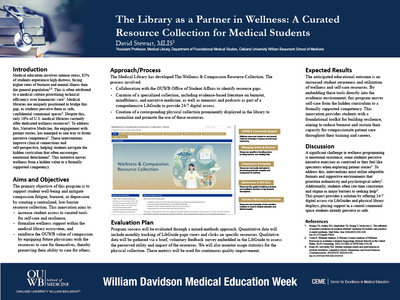
The Library as a Partner in Wellness: A Curated Resource Collection for Medical Students
David Stewart
Publication Date: 5-7-2026
Medical education involves intense stress; 82% of students experience high distress, facing higher rates of burnout and mental illness than the general population2,3. This is often attributed to a medical culture prioritizing technical efficiency over humanistic care1 . Medical libraries are uniquely positioned to bridge this gap, as students perceive them as safe, confidential communal spaces2 . Despite this, only 18% of U.S. medical libraries currently offer dedicated wellness resources2 . To address this, Narrative Medicine, the engagement with patient stories, has emerged as one way to foster narrative competence1 . These interventions improve clinical connections and self-perspective, helping students navigate the hidden curriculum that often encourages emotional detachment1 . This initiative moves wellness from a hidden value to a formally supported competency
-
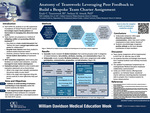
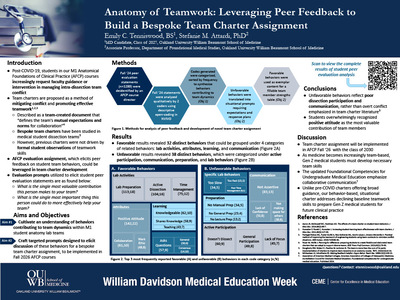
Anatomy of Teamwork: Leveraging Peer Feedback to Build a Bespoke Team Charter Assignment
Emily Tenniswood and Stefanie Attardi
Publication Date: 5-7-2026
Post-COVID-19, students in our M1 Anatomical Foundations of Clinical Practice (AFCP) courses increasingly request faculty guidance or intervention in managing intra-dissection team conflict.
-

Analysis and Monitoring of a Robotics Curriculum: Are SimNow Modules Valuable?
Jacob Applegarth, Ibrahim Baida, Anthony Iacco, Ngan Nguyen, and Nathan Novotny
Publication Date: 4-29-2025
-

Characteristics, Policies, and Practices of Clinical Ethics Fellowship Programs
Amanda Bachand, Ellen Fox, and Jason Adam Wasserman
Publication Date: 5-2025
• While clinical ethics fellowship programs are now commonplace in U.S. hospitals, recent research has revealed significant problems including a shortage of personnel who are appropriately trained to perform ethics consultation, lack of access to high quality training for ethics consultants, and lack of funding for clinical ethics training.1
• Our goal was to accurately describe the characteristics, policies, and practices of existing clinical ethics fellowship programs in the U.S. and Canada as well as the opinions of clinical ethics fellowship program directors regarding program standards, accreditation, and funding through a robust questionnaire.
• This project focused specifically on the development of a cognitive interviewing protocol designed to refine the questionnaire that would be used to measure core constructs of fellowship programs.
-

Publication Trends Among Integrated Plastic Surgery Residency Applicants after the Elimination of Numeric Step 1 Scores
Forrest Bohler, James Burmeister, Ethan Dimock, Ava Harvey, Zachary Koenig, Kongkrit Chaiyasate, and Cameron Davidson
Publication Date: 4-29-2025
-

Integration of safeTALK Training into the Preclinical Curriculum
Riya Chhabra, Shivapriya Chandu, Kristin Sarsfield, Ahmad Abu-Mahfouz, and Berkley Browne
Publication Date: 4-29-2025
-
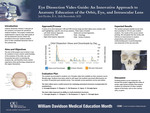
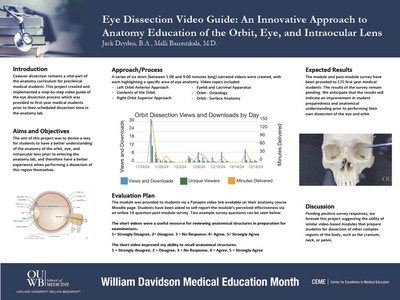
Eye Dissection Video Guide: An Innovative Approach to Anatomy Education of the Orbit, Eye, and Intraocular Lens
Jack Dryden and Malli Barremkala
Publication Date: 4-29-2025
-

Health Education Gaps in South Asian Communities Vary by Age, Sex, and National Origin
Zeeshan Javed, Hashim Aslam, Zaynab Ketana, Tai Metzger, Zaheen Hossain, Shayzal Siddiqui, and Virginia Uhley
Publication Date: 4-21-2025
-

Medical Student Knowledge and Perceptions of Medications for Opioid Use Disorder
Claire Kopachik and Cameron Davidson
Publication Date: 5-13-2025
-

Empowering Underserved Mandarin-Speaking Communities Through Medical Student-Led Culinary Education
Amy Lin, Qihua Sun, Nathan Huang, Virginia Uhley, and Misa Mi
Publication Date: 4-29-2025
-

Survey of Medical Student Attitudes Regarding Uterine Transplant for Cisgender and Transgender Women
Oakland University William Beaumont School of Medicine Medical School Medical Student, Deidre Hurse, and Abram Brummett
Publication Date: 4-29-2025
-

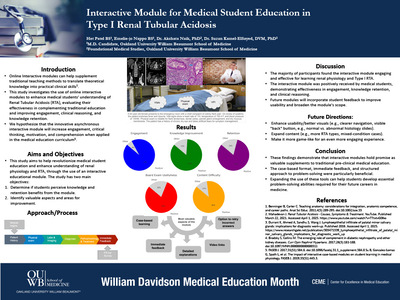
Interactive Module for Medical Student Education in Type I Renal Tubular Acidosis
Het Patel, Emelie-jo Nappo, Akshata Naik, and Suzan Elsayed
Publication Date: 4-29-2025
-

Interactive Module ror Medical Student Education in Type I Renal Tubular Acidosis
Het Patel, Emelie-jo Nappo, Akshata Naik, and Suzan Elsayed
Publication Date: 4-29-2025
-

Can Formative Assessments Pave the Way for Summative Success?: Correlating Anatomy Clinical Integration Laboratories with Examination Performance
Christopher Ramus and Stefanie Attardi
Publication Date: 4-29-2025
-

Associations Between Health Literacy and Comprehension of Health Visits in a Community Setting
Amanda Romaya, Adel Andemeskel, Salim Abdul-Razak, Linda Dillon, and Victoria Lucia
Publication Date: 5-2025
Low health literacy is a significant social determinant of health that is associated with poor health outcomes1-3. Bringing attention to health literacy will aid in promoting the health of the population. However little has been done to implement national policies and interventions that address patient health literacy, especially in a community setting4.
We hypothesized that our assessment of the identified patient population’s health literacy will not meet adequate standards and will indeed demonstrate a need for community-focused interventions
-

Green Prescription: Analyzing and Encouraging Plant-Based Eating for Student Physicians in a Four Week Seminar
Deena Sukhon, Kaithlyn Duong, Corinne Bowditch, Tai Metzger, Jessica Eibling, Amy Lin, Cindy Tran, Jackie Kraft, Maya Jaradi, Vicky Lu, Sophie Fisher, Jacob Keeley, Fanny Huang, and Virginia Uhley
Publication Date: 4-29-2025
-

Bridging the Gap: Overcoming Medical Arabic Language Challenges in the Healthcare Setting
Deena Sukhon, Maya Jaradi, Abdullah Jalal, Marwa Saad, Joud Obri, Wesam Almasri, Matthew Helou, Mazen Zamzam, and Inaya Hajj Hussein
Publication Date: 4-29-2025
-

Overview of the OUWB RISE (Reframing Inclusion through Scholarship & Equity) Program
Tracey A. H. Taylor, Vonda Douglas-Nikitin, Brian Felice, Daniel Menkes, Aqsa Nasir, Michelle Rau, Payal Shah, David Stewart, Rennard Tucker, Ann Voorheis-Sargent, and Tonya C. Bailey
Publication Date: 4-29-2025
Printing is not supported at the primary Gallery Thumbnail page. Please first navigate to a specific Image before printing.