


Files
Download Full Text (385 KB)
Description
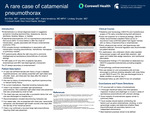
Catamenial pneumothorax is defined as spontaneous pneumothorax within 72 hours before or after the onset of menstruation and is usually associated with thoracic endometriosis syndrome (TES). Endometriosis is the presence of ectopic endometrial tissue outside the uterine cavity. TES includes thoracic manifestations in association with menstruation including pneumothorax, hemothorax, hemoptysis or pulmonary nodules. Catamenial pneumothorax predominantly affects the right lung and is commonly misdiagnosed as spontaneous pneumothorax of unknown etiology [1]. In a review of 490 cases of catamenial pneumothorax, only 55% of patients had pelvic endometriosis and 89% had diaphragmatic involvement [2]. This raises the question of whether catamenial pneumothorax is always secondary to endometriosis, particularly in patients without prior symptoms or diagnosis, as demonstrated in this case.
A 27-year-old G2P0020 female with a history of type II diabetes, hyperbilirubinemia, and obesity presented with right-sided neck, shoulder, back, and chest pain two days after the onset of menstruation. She had no history of endometriosis, significant dysmenorrhea, or relevant family history. She was not taking medications but reported smoking marijuana daily. Chest X-ray revealed a complete right spontaneous pneumothorax. She was hemodynamically stable and underwent right-sided chest tube placement. The air leak resolved by hospital day 3 without surgical intervention, allowing chest tube removal following a successful clamp trial. She was discharged on hospital day 4 with counseling to discontinue marijauna use. Four weeks later, she re-presented with chest pain, tachycardia, tachypnea, and decreased right breath sounds a few days after the last day of her menstrual period. Chest x-ray confirmed a recurrent large right pneumothorax requiring chest tube placement.
In this case, catamenial pneumothorax occurred without a history of endometriosis, highlighting the importance of a thorough menstrual history in cases of spontaneous pneumothorax with unknown etiology and intra-operative inspection of pleura and diaphragm. Future studies should explore contributing risk factors- pelvic endometriosis, smoking, or prior gynecologic surgery-and determine whether these pneumothoraces are true secondary lesions or an independent phenomenon. Best treatment practices remain to be defined.
Publication Date
5-8-2026
Disciplines
Obstetrics and Gynecology
Recommended Citation
Eller B, Huizinga J, Snyder L, Ismailova I. A rare case of catamenial pneumothorax. Presented at: Research Day Corewell Health West; 2026 May 8; Grand Rapids, MI.
Comments
2026 Research Day Corewell Health West, Grand Rapids, MI, May 8, 2026. Abstract 1945