


Files
Download Full Text (1021 KB)
Description
Drug-induced anti-neutrophil cytoplasmic antibody (ANCA)-associated vasculitis (AAV) is a rare subset of AAV commonly caused by hydralazine, thiamazoles, and minocycline. Hydralazine is a common cause of drug-induced ANCA-associated vasculitis and is typically associated with pauci-immune glomerulonephritis, dsDNA antibodies, high titers of MPO-ANCA, anti-histone antibodies, and hypocomplementemia.
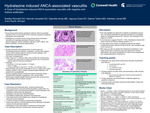
An 84-year-old female with a past medical history of recent deep vein thrombosis/pulmonary embolism on apixaban, coronary artery disease, chronic kidney disease stage 3B and HTN presented with one week of hematochezia and was admitted for a subacute gastrointestinal bleed. She was found to be significantly hypertensive on arrival, consistent with multiple recent emergency department visits for hypertensive urgency treated with intravenous hydralazine. Initial workup was remarkable for a creatinine of 10.58 mg/dL (baseline 1.4-1.6mg/dL), BUN of 77 mg/dL, and urinalysis significant for large blood, >100 RBCs, and 100mg/dL protein. Initial serologic work-up was remarkable for low C3, positive anti-nuclear-antibody, positive c-ANCA, positive myeloperoxidase antibodies, and positive warm autoantibodies. Renal biopsy revealed globally sclerotic glomeruli with one glomerulus demonstrating an active cellular crescent. Anti-histone antibodies were found to be negative.
This case highlights the diagnostic complexity of hydralazine-induced AAV. Anti-histone antibodies are generally described as a serological marker for hydralazine-induced AAV; however, their sensitivity for the diagnosis is limited. Current literature suggests that 43% - 90% of hydralazine-induced AAV cases will have anti-histone antibody positivity. Without a distinctive marker for hydralazine-induced AAV, diagnosis relies on clinical acumen with a temporal exposure to hydralazine, serology data, and improvement of symptoms after medication cessation.
Publication Date
5-8-2026
Disciplines
Internal Medicine
Recommended Citation
Reinoehl B, Campbell H, Abreo G, Doad J, Tallent G, Jarrett K. A case of hydralazine induced ANCA-associated vasculitis with negative anti-histone antibodies. Presented at: Research Day Corewell Health West; 2026 May 8; Grand Rapids, MI.
Comments
2026 Research Day Corewell Health West, Grand Rapids, MI, May 8, 2026. Abstract 2068