


Files
Download Full Text (214 KB)
Description
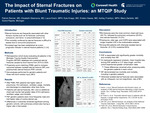
Traumatic sternal fractures present a clinical challenge to risk stratification and management strategies. An increasing burden of rib, clavicle, and scapula fractures with sternal injuries significantly increases adverse outcomes and mortality, although these risks have not been fully defined. Historically, the presence of sternal fractures has also evoked concern for underlying blunt cardiac injury (BCI), although no significant association with isolated sternal fractures has consistently been demonstrated. Therefore, knowledge gaps remain regarding the prognosis of sternal fractures with and without additional chest wall injuries, especially in the geriatric population. To further elucidate the impact of these injuries, this study aims to determine the morbidity conferred by isolated sternal fractures versus those with concurrent thoracic injuries.
This retrospective cohort study evaluated adult blunt trauma patients who sustained sternal fractures from 2015 to 2024. Qualifying patients were extracted from the Michigan Trauma Quality Improvement Program database, which houses information from the registries of 35 Level 1 and 2 trauma centers across the state. The primary outcome was hospital length of stay (LOS) between patients with isolated sternal fractures and those with additional chest wall injuries. Further sub-analysis of this outcome with a geriatric cohort was also performed. Secondary objectives included determination of differences in ventilator days, blunt cardiac injury, and adverse hospital events among these cohorts. Deidentified data was transferred to a statistician for extraction and analysis. Numeric outcomes were expressed as mean ± standard deviation. Propensity score matching (PSM) was used to compare isolated (ISF) and polytraumatic sternal fracture (PSF) cohorts. Significance was defined as p < 0.05.
822 patients had ISF, while 1,659 patients comprised the PSF cohort. The most commonly associated thoracic injury in the PSF cohort was rib fractures (59.7%), followed by pulmonary contusions (25.6%), clavicle fractures (10.2%), BCI (9.0%), and scapula fractures (2.5%). ISF patients were older and less frequently male. They had significantly higher rates of hypertension and steroid use, and a lower rate of tobacco abuse. After PSM, PSF patients had a significantly longer hospital LOS, which was 3.37 days longer than ISF patients (p< 0.0001). Additionally, the ISF cohort had significantly less in-hospital mortality, fewer ICU admissions, and lower rates of pneumonia, intubation, and ventilator usage. Among geriatric trauma patients, ISF patients were still less frequently male and more likely to use steroids routinely. After PSM, the geriatric PSF cohort had longer hospital LOS, greater in-hospital mortality, and higher rates of pneumonia, intubation, ventilator usage, ICU admission, and PE development.
In this retrospective study, we demonstrate that PSF is associated with significantly greater morbidity and mortality than ISF. The mean hospital stay among PSF patients is 3.37 days longer, and this cohort experienced greater rates of in-hospital mortality, ICU admission, pneumonia, intubation, and ventilator dependence. These significant differences remained when analyzing solely the geriatric patients in each cohort. Future studies should analyze the compounding effect of sternal fractures on patients with rib fractures.
Publication Date
5-8-2026
Disciplines
Surgery
Recommended Citation
Renner P, Steensma E, Krech L, Knapp K, Hawes K, Franklyn A, Zambito M. The impact of sternal fractures in patients with blunt thoracic injury. Presented at: Research Day Corewell Health West; 2026 May 8; Grand Rapids, MI.
Comments
2026 Research Day Corewell Health West, Grand Rapids, MI, May 8, 2026. Abstract 2098