


Files
Download Full Text (122 KB)
Description
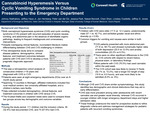
Both cannabinoid hyperemesis syndrome (CHS) and cyclic vomiting syndrome (CVS) present with recurrent episodes of severe nausea, vomiting, and abdominal pain in the absence of identifiable organic pathology, leading to frequent misdiagnosis and unnecessary interventions. Despite overlapping clinical features, inconsistent literature makes differentiating between CHS and CVS challenging in children. This retrospective study aims to compare disease patterns, demographics, clinical features, and treatment outcomes between patients with CHS and CVS to develop a more pragmatic diagnostic approach.
This was a retrospective cohort analysis of consecutive children (< 18 years old) diagnosed with CHS or CVS. Patients were seen at eight emergency departments (EDs) over an 8-month study period. Spanning 13 counties in Michigan, affiliated institutions included five rural medical centers, two university-affiliated hospitals, and a children's tertiary care facility. Data collected included demographics, clinical features, and treatment outcomes in children with CHS versus CVS. The Kruskal-Wallis and unpaired t-tests were used to compare these two groups across key demographic and outcome variables.
During the study period, 111 children met the inclusion criteria, 36 (32.4%) had documented CHS, and 75 (67.6%) had CVS. Children with CHS were older (17.5 vs. 12.3 years; p < 0.001), predominantly male (57.1 vs. 42.7%; p = 0.157), and exhibited greater racial and ethnic diversity (p = 0.005). CHS patients presented with more abdominal pain (77.8 vs. 58.7%, p=0.049) and showed numerically higher rates of both depression (25.0 vs 12.0%, p = 0.083) and anxiety comorbidities (22.2% vs 9.3%, p = 0.064). Most patients with CVS (76.5%) had used cannabis within the past week. The CVS cohort was less likely to receive IV fluids (52.1% vs. 72.2%, p = 0.045), had a longer ED length of stay (10.9 vs. 6.0 hours, p = 0.053), and was more likely to be admitted (8.0% vs. 0%, p = 0.082).
Although CHS and CVS share similar symptomatology, this study identifies key demographic and clinical distinctions that may aid in early differentiation. CHS was more prevalent among older adolescents with recent cannabis use and greater racial diversity, whereas CVS occurred in younger children with longer emergency department stays and higher admission rates. These findings underscore the need for prospective studies to refine diagnostic criteria and optimize management strategies for pediatric patients with recurrent vomiting syndromes.
Publication Date
5-8-2026
Disciplines
Emergency Medicine
Recommended Citation
Haus J, Stathakios J, Hemberg J, van der Eb P, Park J, Bennett N, Shen C, Jones J. Cannabinoid hyperemesis versus cyclic vomiting syndrome in children presenting to the emergency department. Presented at: Research Day Corewell Health West; 2026 May 8; Grand Rapids, MI.
Comments
2026 Research Day Corewell Health West, Grand Rapids, MI, May 8, 2026. Abstract 1877