












-

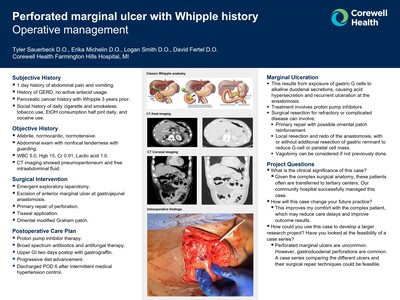
Perforated Marginal Ulcer with Whipple History Operative Management
Tyler Sauerbeck, Erika Michelin, and Logan Smith
Publication Date: 5-9-2024
1 day history of abdominal pain and vomiting.
History of GERD, no active antacid usage.
Pancreatic cancer history with Whipple 3 years prior.
Social history of daily cigarette and smokeless. tobacco use, EtOH consumption half pint daily, and cocaine use.
-

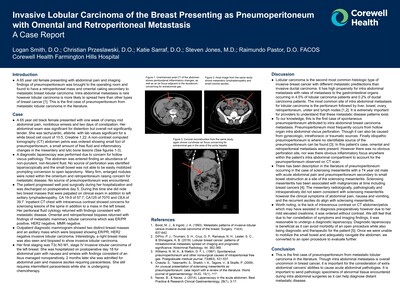
Invasive Lobular Carcinoma of the Breast Presenting as Pneumoperitoneum with Omental and Retroperitoneal Metastasis: A Case Report
Logan Smith, Christian Przeslawsk, Katie Sarraf, Steven Jones, and Raimundo Pastor
Publication Date: 5-9-2024
A 65 year old female presenting with abdominal pain and imaging findings of pneumoperitoneum was brought to the operating room and found to have a retroperitoneal mass and omental caking secondary to metastatic breast lobular carcinoma. Intra abdominal metastasis is rare however lobular carcinoma is more likely to spread here than other types of breast cancer. This is the first case of pneumoperitoneum from metastatic lobular carcinoma in the literature.
-

A Penetrating Neck Injury Resulting in Complete Transection of the Ipsilateral Common Carotid Artery, Delayed Contralateral Pneumothorax and Occult Esophageal Injury: A Case Report with a Multidisciplinary Approach to Management
Michaela Knaggs, Christian Przeslawski, Peter Habib, Ahmed Ghamraoui, Caitlin Wahl, and Jeffrey Gerken
Publication Date: 5-4-2023
A 29-year-old male presented a zone one penetrating neck injury. He had a proximal common carotid artery and internal jugular vein injuries which were successfully managed with vessel ligation. Patient also had an occult esophageal injury at the junction of the cervical and thoracic esophagus which was successfully managed with wide drainage of the neck and right chest.
-
Effectiveness of a Modified Difficult Colonoscopy Score A Retrospective Review of General Surgeon Performed Colonoscopies at a Community Hospital
Killian Llewellyn, Lianne Caceres, Karen Childers, and John Parmely
Publication Date: 5-4-2023
Colonoscopy remains the mainstay of screening for colon cancer in the US and an essential operating room skill for general surgeons.
▪ A quality review was performed of general surgeons at a community hospital.
▪ Difficult Colonoscopy Score (DCS) was a score created to predict difficulty of colonoscopy which was defined as prolonged intubation time, need for external compression, or increased pain score [1]. We tested the utility in our community and resident-involved endoscopy department.
-

Traumatic Thoracostomy Tube Management at a Community Hospital A Retrospective Review
Christian Przeslawski, Peter Habib, Kita Mack, Vimal Love, Julie George, and Amelia Pasley
Publication Date: 5-4-2023
Thoracostomy tubes or chest tubes (CT) have been a mainstay in thoracic trauma treatment since the Vietnam war with their roots dating back to the 5th century [1]. Trauma is the number one cause of death in the world, with chest trauma being the second highest cause of trauma related death [2]. 18% of patients with a blunt thoracic injury require chest tube. Management varies widely and there is no general consensus on management [3].
-
Aberrant Diagnostic Imaging Resulting in Misdiagnosed Acute Perforated Appendicitis A Case Report
Christian Przeslawski, Leanne Iorio, and Jeffrey Gerken
Publication Date: 5-4-2023
300,000 appendectomies are performed every year in the United States with lifetime risk of acute appendicitis in the United States is approximately 9% [1,2].
We present a case where initial diagnostic imaging was consistent with perforated sigmoid diverticulitis with definitive diagnosis at the time of surgery being acute perforated appendicitis.
-

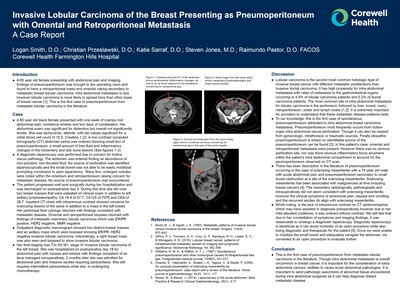
Invasive Lobular Carcinoma of the Breast Presenting as Pneumoperitoneum with Omental and Retroperitoneal Metastasis A Case Report
Logan Smith, Christian Przeslawski, Katie Sarraf, Steven Jones, and Raimundo Pastor
Publication Date: 5-5-2023
A 65 year old female presenting with abdominal pain and imaging findings of pneumoperitoneum was brought to the operating room and found to have a retroperitoneal mass and omental caking secondary to metastatic breast lobular carcinoma. Intra abdominal metastasis is rare however lobular carcinoma is more likely to spread here than other types of breast cancer [1]. This is the first case of pneumoperitoneum from metastatic lobular carcinoma in the literature.
-
Relationship Between Obesity and Triple-Negative Breast Cancer: A Retrospective Study
Mariam Aoun, Anna Jahshan, Nayana Dekhne, and Varna Taranikanti
Publication Date: 5-2-2022
INTRODUCTION
/="/">Several research studies have identified a positive correlation between obesity and specific receptor statuses in breast cancer, including ER-positive, PR-positive, and HER2-positive breast cancers. However, triple-negative breast cancer (TNBC) in particular has not been studied in relation to body mass index (BMI), which suggests that an analysis of triple-negative breast cancer and its relation to obesity is warranted. This study aims to analyze the association between triple-negative breast cancer and BMI through a retrospective analysis in order to further guide patient counseling about TNBC risk factors. -

Multiple Endocrine Neoplasia Type 1 in a Young Man With Seizures
Nitya Batra, Nishant Aggarwal, Shailesh Niroula, Daniel Misra, Peter Czako, and Daniel Shelden
Publication Date: 10-2022
Introduction
Multiple endocrine neoplasia type 1 (MEN1) is an autosomal dominant disorder involving mutation of the MEN1 gene. Clinically it is defined by tumors of the pituitary, parathyroid, and the entero-pancreatic endocrine cells. Other tumors have been associated with MEN1. We present a case of a previously healthy young man presenting with seizures.
Discussion
We present a classic case of MEN1 in a patient with significant family history with the presence of primary hyperparathyroidism, pituitary microadenoma, and duodenopancreatic NETs. • Interestingly, rare presentation of MEN1 as refractory seizures have been reported secondary to hyperinsulinemic hypoglycemia, but our patient was euglycemic with appropriate levels of insulin and C-peptide. This suggests an alternative etiology that is not well documented in available literature. • Given the complex and highly specialized skills needed to diagnose and treat MEN1, involvement of a multidisciplinary team is vital.
Conclusion When the clinical suspicion for MEN1 is high, endocrinology evaluation with appropriate laboratory workup and targeted imaging of the typical endocrine organs as described for this patient are advised with careful multidisciplinary management and follow-up.
-
Incidental Pathogenic Fibrin-Associated Diffuse Large B-Cell Lymphoma Found During Aorto-Biiliac Bypass
Peter Habib, Thomas Serena, Caitlin Flynn, Aaron Hartkop, Elizabeth Wey, David Lang, and Eugene Laveroni Jr
Publication Date: 5-2022
Introduction • Fibrin-associated diffuse large B-cell lymphoma (FA-DLBCL) is an extremely rare form of Epstein-Barr virus positive (EBV+) non-Hodgkin’s lymphoma. • This case presents a rare and unique presentation of a pathological non-Hodgkin’s lymphoma
-

Relationship Between Smoking and Triple-Negative Breast Cancer: A Retrospective Analysis
Anna Jahshan, Mariam Aoun, Nayana Dekhne, and Varna Taranikanti
Publication Date: 5-2-2022
INTRODUCTION
Breast cancer is currently the most common cancer by incidence among women in the United States with high mortality. Compared to other specific types, triple-negative breast cancer (TNBC) is considered to be an aggressive cancer with poor prognosis. Hence, it is important to study the risk factors associated with it. Smoking has been implicated in many cancers, including breast cancer. However, there is no evidence in literature that has shown a relationship between smoking and a specific type of breast cancer. The goal of this study is to analyze the relationship between smoking and TNBC so that we may improve the understanding of the risk factors related to this type of breast cancer. -

Clearance of the Cervical Spine in Obtunded Pediatric Blunt Trauma Patients: Quality Assessment of an Existing Clearance Pathway
Rachel Kalthoff, Elizabeth Boudiab, Diane Studzinski, Nathan Novotny, Pavan Brahmamdam, and Begum Akay
Publication Date: 5-2-2022
INTRODUCTION
Obtunded patients following blunt trauma need clearance of the cervical spine (c-spine) that cannot depend on a clinical exam. Our center’s current pediatric c-spine evaluation pathway includes both Computed Tomography (CT) and Magnetic Resonance Imaging (MRI). The objective of this study was to review our use of both CT and MRI for obtunded pediatric trauma patients to assess the quality of our pathway and utility of MRI. -

Factors Influencing Reintubation in Self Extubated Pediatric Intensive Care Unit Patients
Ahmed Naseem, Ameer Al-Hadidi, Morta Lapkus, Patrick Karabon, Begum Akay, and Paras Khandar
Publication Date: 5-2-2022
NTRODUCTION
Intubated pediatric patients that self-extubate may be particularly susceptible to reintubation. Identifying factors that increase risk of reintubation allows for better monitoring and response in cases of self-extubation and can potentially identify patients needing reintubation. -
Radioactive iodine therapy (RAIT) in N1 papillary thyroid cancer: Are we overtreating?
Elizabeth Odil, Jordan Reilly, Fionna Sun, Diane Studzinski, Rose E. Callahan, and Sapna Nagar
Publication Date: 4-28-2022
-

A Rare Case of Subcutaneous Panniculitis-Like T-cell Lymphoma
Blake Seelbinder, Angela Kim, Marcos Rosado, Mohamed Musheinesh, Amanda Cimino, John Pui, Armen Korkigian, and Craig Gordon
Publication Date: 5-2022
Subcutaneous panniculitis-like T-cell lymphoma (SPTCL) is a rare and typically slow growing variant of T-cell lymphoma. The clinical course usually mimics infectious panniculitis. It characteristically affects the subcutaneous adipose tissue of the trunk or extremities without resultant lymph node involvement. It comprises
-

Association of Gut Metabolomic Biomarkers with Sleeve Gastrectomy Weight-Loss Outcomes
Pamela Spicer, Wendy Miller, Kathryn Ziegler, and Stewart Graham
Publication Date: 5-2-2022
INTRODUCTION
Obesity is a prevalent health challenge with high morbidity and many associated chronic diseases. Sleeve gastrectomy is currently the predominant intervention for obesity. However, weight loss results are variable. The mechanisms and factors influencing this variability are not well understood. We evaluated the correlation of metabolomic biomarkers with weight-loss.
Printing is not supported at the primary Gallery Thumbnail page. Please first navigate to a specific Image before printing.