






-
Kern National Network at OUWB: Helping Medical Student Ideas Come to Life While Promoting Student Wellness and Academic Success
Shivapriya Chandu, Ahmad Abu-Mahfouz, Rohit Ray, Riya Chhabra, and Berkley Browne-Holtz
Publication Date: 5-7-2026
Poster Winner - Medical students experience evolving stressors and wellness needs throughout training. From preclinical coursework to board preparation and clinical rotations, priorities may shift over time. This project addresses the following research question: How can we effectively improve student wellness initiatives through student engagement during the M1- M3 medical school years?
-
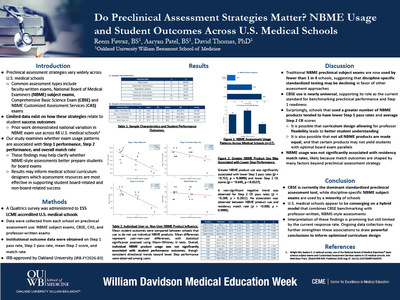
Do Preclinical Assessment Strategies Matter? NBME Usage and Student Outcomes Across U.S. Medical Schools
Reem Fawaz, Aaryan Patel, and David Thomas
Publication Date: 5-7-2026
Preclinical assessment strategies vary widely across U.S. medical schools. Limited data exist on how these strategies relate to student success outcomes. Our study examines whether exam usage patterns are associated with Step 1 performance, Step 2 performance, and overall match rate.
-

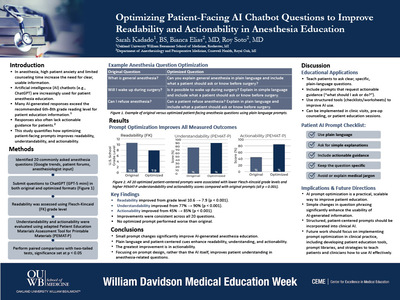
Optimizing Patient-Facing AI Chatbot Questions to Improve Readability and Actionability in Anesthesia Education
Sarah Kadado, Bianca Elias, and Roy Soto
Publication Date: 5-7-2026
In anesthesia, high patient anxiety and limited counseling time increase the need for clear, usable information. Artificial intelligence (AI) chatbots (e.g., ChatGPT) are increasingly used for patient anesthesia education. Many AI-generated responses exceed the recommended 6th-8th grade reading level for patient education information. Responses also often lack actionable guidance for patients. This study quantifies how optimizing patient-facing prompts improves readability, understandability, and actionability.
-
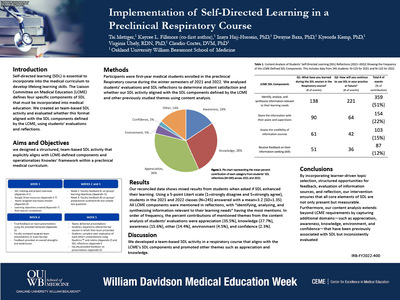
Implementation of Self-Directed Learning in Preclinical Respiratory Course
Tai Metzger, Kaycee L. Fillmore, Inaya Hajj-Hussein, Dwayne Baxa, Kyeorda Kemp, Virginia Uhley, and Claudio Cortes
Publication Date: 5-7-2026
Self-directed learning (SDL) is essential to incorporate into the medical curriculum to develop lifelong learning skills. The Liaison Committee on Medical Education (LCME) defines four specific components of SDL that must be incorporated into medical education. We created an team-based SDL activity and evaluated whether this format aligned with the SDL components defined by the LCME, using students’ evaluations and reflections.
-

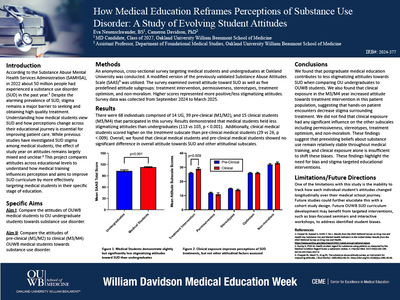
How Medical Education Reframes Perceptions of Substance Use Disorder: A Study of Evolving Student Attitudes
Eva Neueunschwander and Cameron Davidson
Publication Date: 5-7-2026
According to the Substance Abuse Mental Health Services Administration (SAMHSA), in 2022 about 50 million people had experienced a substance use disorder (SUD) in the past year.1 Despite the alarming prevalence of SUD, stigma remains a major barrier to seeking and obtaining high quality treatment. Understanding how medical students view SUD and how perceptions change across their educational journey is essential for improving patient care. While previous studies have investigated SUD stigma among medical students, the effect of study year on attitudes remains largely mixed and unclear.2 This project compares attitudes across educational levels to understand how medical training influences perception and aims to improve SUD curriculum by more effectively targeting medical students in their specific stage of education.
-
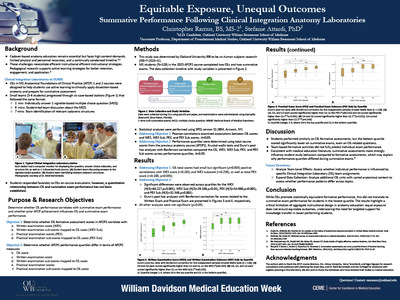
Equitable Exposure, Unequal Outcomes Summative Performance Following Clinical Integration Anatomy Laboratories
Christopher Ramus and Stefanie Attardi
Publication Date: 5-7-2026
Cadaver-based anatomy education remains essential but faces high content demands, limited physical and personnel resources, and a continually condensed timeline. These challenges necessitate efficient instructional efficient instructional strategies. Pedagogical research supports active learning strategies for better retention, engagement, and application.
-
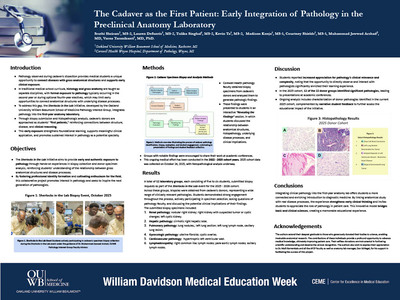
The Cadaver as the First Patient: Early Integration of Pathology in the Preclinical Anatomy Laboratory
Sruthi Shriram, Lauren DeSantis, Tulika Singhal, Kevin Ta, Courtney Shields, Muhammad Jawwad Arshad, Varna Taranikanti, and Madison Konja
Publication Date: 5-7-2026
-
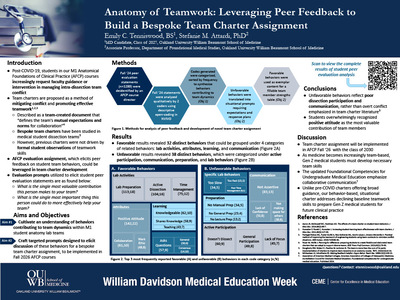
Anatomy of Teamwork: Leveraging Peer Feedback to Build a Bespoke Team Charter Assignment
Emily Tenniswood and Stefanie Attardi
Publication Date: 5-7-2026
Post-COVID-19, students in our M1 Anatomical Foundations of Clinical Practice (AFCP) courses increasingly request faculty guidance or intervention in managing intra-dissection team conflict.
-
Perceptions of Radiology Residency Staffing Models Across Years of Training
Alex Zhang, Alexander Swantek, Adela Pouzar, and Sayf Al-Katib
Publication Date: 5-7-2026
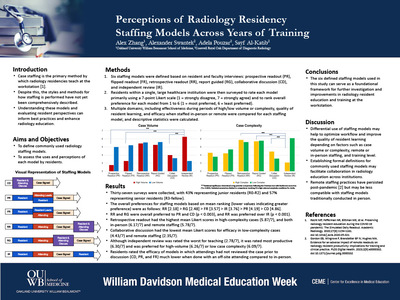
Case staffing is the primary method by which radiology residencies teach at the workstation. Despite this, the styles and methods for how staffing is performed have not yet been comprehensively described. Understanding these models and evaluating resident perspectives can inform best practices and enhance radiology education.
-

Characteristics, Policies, and Practices of Clinical Ethics Fellowship Programs
Amanda Bachand, Ellen Fox, and Jason Adam Wasserman
Publication Date: 5-2025
• While clinical ethics fellowship programs are now commonplace in U.S. hospitals, recent research has revealed significant problems including a shortage of personnel who are appropriately trained to perform ethics consultation, lack of access to high quality training for ethics consultants, and lack of funding for clinical ethics training.1
• Our goal was to accurately describe the characteristics, policies, and practices of existing clinical ethics fellowship programs in the U.S. and Canada as well as the opinions of clinical ethics fellowship program directors regarding program standards, accreditation, and funding through a robust questionnaire.
• This project focused specifically on the development of a cognitive interviewing protocol designed to refine the questionnaire that would be used to measure core constructs of fellowship programs.
-

Publication Trends Among Integrated Plastic Surgery Residency Applicants after the Elimination of Numeric Step 1 Scores
Forrest Bohler, James Burmeister, Ethan Dimock, Ava Harvey, Zachary Koenig, Kongkrit Chaiyasate, and Cameron Davidson
Publication Date: 4-29-2025
-

NBME Synthesis Exam Study
Riya Chhabra, Shivapriya Chandu, Lindsay Gallagher, and David Thomas
Publication Date: 4-29-2025
-

Integration of safeTALK Training into the Preclinical Curriculum
Riya Chhabra, Shivapriya Chandu, Kristin Sarsfield, Ahmad Abu-Mahfouz, and Berkley Browne
Publication Date: 4-29-2025
-

Prevalence of Eating Disorder Risk Among Medical Students in a United States Medical School
Jessica Cummings and Madison McClune
Publication Date: 4-29-2025
-
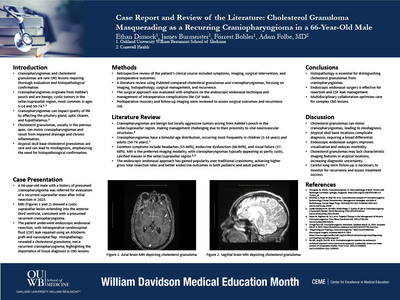
Case Report and Review of the Literature: Cholesterol Granuloma Masquerading as a Recurring Craniopharyngioma in a 66-Year-Old Male
Ethan Dimock, James Burmeister, Forrest Bohler, and Adam Folbe
Publication Date: 4-29-2025
-
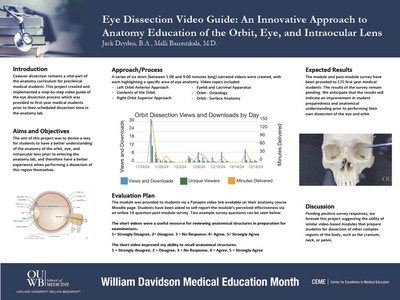
Eye Dissection Video Guide: An Innovative Approach to Anatomy Education of the Orbit, Eye, and Intraocular Lens
Jack Dryden and Malli Barremkala
Publication Date: 4-29-2025
-

Health Education Gaps in South Asian Communities Vary by Age, Sex, and National Origin
Zeeshan Javed, Hashim Aslam, Zaynab Ketana, Tai Metzger, Zaheen Hossain, Shayzal Siddiqui, and Virginia Uhley
Publication Date: 4-21-2025
-

Medical Student Knowledge and Perceptions of Medications for Opioid Use Disorder
Claire Kopachik and Cameron Davidson
Publication Date: 5-13-2025
-

Empowering Underserved Mandarin-Speaking Communities Through Medical Student-Led Culinary Education
Amy Lin, Qihua Sun, Nathan Huang, Virginia Uhley, and Misa Mi
Publication Date: 4-29-2025
-

Survey of Medical Student Attitudes Regarding Uterine Transplant for Cisgender and Transgender Women
Oakland University William Beaumont School of Medicine Medical School Medical Student, Deidre Hurse, and Abram Brummett
Publication Date: 4-29-2025
-

Interactive Module for Medical Student Education in Type I Renal Tubular Acidosis
Het Patel, Emelie-jo Nappo, Akshata Naik, and Suzan Elsayed
Publication Date: 4-29-2025
-

Can Formative Assessments Pave the Way for Summative Success?: Correlating Anatomy Clinical Integration Laboratories with Examination Performance
Christopher Ramus and Stefanie Attardi
Publication Date: 4-29-2025
-

Associations Between Health Literacy and Comprehension of Health Visits in a Community Setting
Amanda Romaya, Adel Andemeskel, Salim Abdul-Razak, Linda Dillon, and Victoria Lucia
Publication Date: 5-2025
Low health literacy is a significant social determinant of health that is associated with poor health outcomes1-3. Bringing attention to health literacy will aid in promoting the health of the population. However little has been done to implement national policies and interventions that address patient health literacy, especially in a community setting4.
We hypothesized that our assessment of the identified patient population’s health literacy will not meet adequate standards and will indeed demonstrate a need for community-focused interventions
-

Bridging the Gap: Overcoming Medical Arabic Language Challenges in the Healthcare Setting
Deena Sukhon, Maya Jaradi, Abdullah Jalal, Marwa Saad, Joud Obri, Wesam Almasri, Matthew Helou, Mazen Zamzam, and Inaya Hajj Hussein
Publication Date: 4-29-2025
-

Innovating Team Dynamics: Implementation of Bespoke Team Charters within Medical Student Dissection Teams
Emily Tenniswood and Stefanie Attardi
Publication Date: 4-29-2025
EDUCATIONAL INNOVATION WINNER
Printing is not supported at the primary Gallery Thumbnail page. Please first navigate to a specific Image before printing.