




-

Safety Profile of Spinal Cord Stimulator Paddle Lead Revision and Replacement
Saini Kethireddy and Michael Staudt
Publication Date: 5-2025
- Spinal cord stimulation (SCS) is a neuromodulatory treatment for patients experiencing chronic pain resistant to conservative therapies. It is often used for postlaminectomy syndrome, complex regional pain syndrome, and neuropathic pain.
- SCS leads can be categorized into percutaneous leads and paddle leads, the latter requiring a laminectomy for implantation.
- The advantages of paddle leads include lower migration rates and more efficient energy delivery.
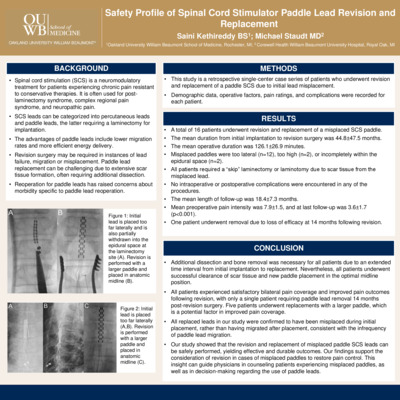
- Revision surgery may be required in instances of lead failure, migration or misplacement. Paddle lead replacement can be challenging due to extensive scar tissue formation, often requiring additional dissection.
- Reoperation for paddle leads has raised concerns about morbidity specific to paddle lead reoperation.
-

Understanding the Effect of Advanced Patient Age on Outcomes and Complications of Spinal Surgery
Alexander R. Woznicki and Daniel K. Fahim
Publication Date: 5-2025
• In 2020, 6.7 million individuals in the United States were older than 85. This is projected to increase to 12.6 million in 20601
• The risk of developing many spinal conditions increases with age2,3,4
• Decreases in disk height changes the loadbearing properties of the spine
• Decreased bone density makes the vertebrae susceptible to fracture
• Weakening of spinal ligaments predispose to disc degeneration
• Hypertrophy of the ligamentum flavum and susceptibility to disk herniation can lead to spinal stenosis
• Damage of the cervical spinal cord can manifest as weakness and clumsiness in the upper extremities and gait disturbances2, while lumbar spinal cord damage often presents with severe pain and decreased mobility
• Upper extremity weakness and clumsiness may leave patients unable to adequately feed themselves or perform other activities of daily living (ADLs)4, while gait disturbances are correlated with falls6,7,8,9, fractures7,8, and increased mortality10 • Reduced mobility is correlated with an increased risk of developing thromboemboli11,12, pneumonia13, heart disease4, and increased mortality14,15
• Back pain in elderly individuals is correlated with inability to perform ADLs, functional impairment, sleep disorders, depressive symptoms, increased use of healthcare resources, heart disease, and mortality4
• Elderly individuals present with spinal conditions more frequently than younger individuals and may greatly benefit from receiving surgery4. However, age is a known risk factor for surgical complications16, particularly spine surgery17
• The question of how old is too old remains to be answered18. This study hopes to identify the relative rates of surgical complications and range of outcomes in elderly patients to determine whether super-elderly patients are likely to benefit from spinal surgery
-
Responsive Neurostimulation (RNS) of the Centromedian Nucleus (CMN) of the Thalamus for the Treatment of Drug Resistant Idiopathic Generalized Epilepsy (IGE)
Angelique Manasseh, Hannah Guider, Brooklynn Bondy, Sanjay Patra, David Burdette, M. Ayman Haykal, Nour Baki, Ashleigh Terrell, Michael Staudt, Christopher Parres, and Andrew Zillgitt
Publication Date: 5-9-2024
Idiopathic generalized epilepsy (IGE) accounts for nearly 1/3 of all epilepsies.
Approximately 20-30% of people with IGE are refractory to adequate anti-seizure medication trials.
RNS implantation is a unique closed-loop neuromodulation therapy, and case reports as well as case series have demonstrated improved seizure control in patients with drug resistant IGE.
More recently, targeting the centromedian nucleus of the thalamus with RNS has been explored as a potential surgical treatment option for patients with drug resistant IGE.
-

Quantitative and Comparative Analysis of Dream Content in Parkinson’s Disease patients Pre- and PostDeep Brain Stimulation
Sarvar Oreizi-Esfahani and Michael Staud
Publication Date: 5-2024
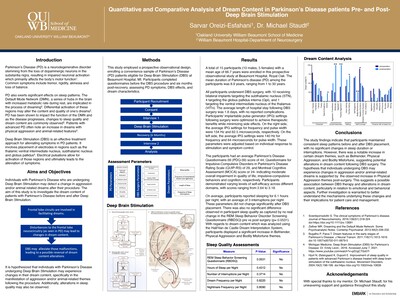
Parkinson’s Disease (PD) is a neurodegenerative disorder stemming from the loss of dopaminergic neurons in the substantia nigra, resulting in impaired neuronal activation which primarily affects the body’s motor function1. Common symptoms include tremor, rigidity, akinesia and loss of balance.
PD also exerts significant effects on sleep patterns. The Default Mode Network (DMN), a series of hubs in the brain with increased metabolic rate during rest, are implicated in the process of dreaming2. Differential activation of these regions may alter the content and quality of one’s dreams2. PD has been shown to impact the function of the DMN and as the disease progresses, changes to sleep quality and dream content are commonly observed3. Patients with advanced PD often note an increase in dreams with physical aggression and animal-related features3.
Deep Brain Stimulation (DBS) is an effective treatment approach for alleviating symptoms in PD patients. It involves placement of electrodes in regions such as the thalamic ventral intermediate nucleus, subthalamic nucleus and globus pallidus4. Electrical pulsations allow for activation of those regions and ultimately leads to the alleviation of symptoms.
Printing is not supported at the primary Gallery Thumbnail page. Please first navigate to a specific Image before printing.