


Files
Download Full Text (123 KB)
Description
The Brain Injury Guidelines (BIG) are a risk-stratification framework that categorizes patients with traumatic intracranial hemorrhage (ICH) into three tiers of increasing severity (BIG 1-3) based on various clinical and radiographic risk variables, with the most severe category designated BIG 3. Under the BIG, all patients taking aspirin are classified as BIG 3 regardless of other clinical variables. Anecdotally, physicians at our institution have observed that patients categorized as BIG 3 solely due to aspirin use generally experience favorable outcomes versus other BIG 3 patients. However, a small subset of these patients at our institution required invasive neurosurgical interventions (NSI). Our study aims to characterize this population and evaluate risk factors for neurosurgical intervention in these patients classified as BIG 3 solely due to aspirin use.
We conducted a retrospective single-center observational study of 36 adult traumatic ICH patients who met criteria for BIG 3 solely on the basis of aspirin use and underwent a neurosurgical intervention for management between 2020 and 2023. Clinical, demographic, radiographic variables, and operative procedures performed were extracted from the electronic medical record. Hemorrhage type, chronicity, location, and cerebral atrophy were obtained from radiology reports. NSI was defined as craniotomy, craniectomy, Burr hole, or placement of bedside intracranial pressure monitors or ventriculostomy drains. Statistical analysis was not performed due to the limited population size and our goal of characterizing this population.
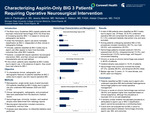
36 patients met the inclusion criteria. 30 patients (83.3%) underwent NSI in the operating room while 6 (16.7%) underwent NSI only at the bedside. Operative NSI involved craniotomy (56.7%), burr hole (30.0%) and craniectomy (20.0%). Hemorrhage patterns were subdural (94.4%), subarachnoid (41.7%), intraparenchymal (19.4%), and intraventricular (19.4%), with frequent concomitant hemorrhages. 15 patients (41.7%) suffered a chronic or acute-on-chronic bleed. Cerebral atrophy was noted in 7 (19.4%). Hemorrhage location was frontal (97.2%), parietal (88.9%), and temporal (80.6%) lobes. Compared with the overall cohort, patients requiring NSI were younger (median 72 vs 78 years), less often female (31.1% vs. 44.6%), and had similar ethnicity.
BIG 3 patients solely due to aspirin who underwent NSI demonstrate heterogeneity in hemorrhage characteristics, varied operative management, and a 42% incidence of chronic component of hemorrhage. The literature does not define a baseline rate of pre-existing chronic ICH in acute traumatic ICH, though this is very high compared to the expert radiologists we queried. It is unclear if this finding is unique to aspirin use or BIG 3 patients. Future work will evaluate the full BIG 3 cohort to assess associations between chronic hemorrhage, aspirin use, NSI, and outcomes.
Publication Date
5-8-2026
Disciplines
Trauma
Recommended Citation
Pardington J, Mormol J, Watson N, Chamberlain A. Characterizing aspirin-only brain injury guidelines class 3 patients requiring operative neurosurgical intervention. Presented at: Research Day Corewell Health West; 2026 May 8; Grand Rapids, MI.
Comments
2026 Research Day Corewell Health West, Grand Rapids, MI, May 8, 2026. Abstract 2122