


Files
Download Full Text (1.7 MB)
Description
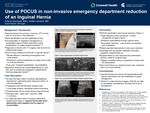
Inguinal hernias are common. Acute ED presentations require prompt diagnosis and risk stratification. Patients without signs of complication may undergo reduction and outpatient follow-up, whereas signs of bowel obstruction or strangulation necessitate urgent surgical evaluation. Diagnosis is often clinical, with adjunct imaging reserved for cases of uncertainty, most commonly computed tomography. Ultrasound demonstrates similar efficacy while offering advantages of low cost, accessibility, and rapid confirmation of reduction. Point-of-care ultrasound (POCUS) has shown comparable diagnostic accuracy, particularly in detecting incarceration and strangulation, and the potential to reduce progression to surgery when used during manual reduction of inguinal hernias. This case from a small, critical access ED highlights the utility of POCUS in managing hernia complications.
An 83-year-old male with past medical history including hypertension, hyperlipidemia, venous thromboembolism on anticoagulant medication, and abdominal aortic aneurysm (AAA) presented to a community-hospital emergency department for left lower quadrant (LLQ) abdominal pain and decreased bowel movements. The patient described one week of sharp, intermittent, 8/10 intensity pain with associated nausea and denied blood in his stool. Physical exam demonstrated LLQ abdominal tenderness, with no obvious hernia appreciated. The initial differential diagnosis included diverticulitis, bowel obstruction, and inguinal hernia. Pertinent lab values included Lactic acid 1.5 mmol/L, Bicarbonate 28 mmol/L, Creatinine 1.10 mg/dL and White Blood Cells 11.40 x10³ /uL. A CT scan of the abdomen and pelvis with IV contrast was performed. Pertinent findings included a stable AAA, dilated loops of bowel, and a left inguinal hernia containing a short descending colon segment without signs of incarceration.
Inguinal hernias are a common emergency department presentation where prompt confirmation and risk stratification is required to guide management. Accurate distinction is critical, as complications such as bowel obstruction or strangulation require emergent surgical evaluation, whereas uncomplicated cases may be managed outpatient. While CT is often pursued, point of care ultrasound offers an accessible, cost-effective, accurate tool for physicians in the diagnosis, stratification of risk, and bedside management in patients presenting with inguinal hernias.
Publication Date
5-8-2026
Disciplines
Emergency Medicine
Recommended Citation
Gonzales A, Johnson J. Use of point of care ultrasound (POCUS) in non-invasive emergency department reduction of an inguinal hernia. Presented at: Research Day Corewell Health West; 2026 May 8; Grand Rapids, MI.
Comments
2026 Research Day Corewell Health West, Grand Rapids, MI, May 8, 2026. Abstract 1962