


Files
Download Full Text (465 KB)
Description
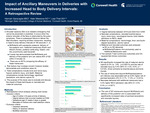
Shoulder dystocia (SD) is an obstetric emergency and is diagnosed during delivery when there is failure to deliver the fetal shoulders with gentle downward traction, resulting in the need for ancillary maneuvers and a head to body delivery interval (HBDI) of >60 seconds. Existing literature on the implications of ancillary maneuvers is limited, particularly those other than McRoberts maneuver and posterior arm delivery, given the poor predictive value of risk factors and the lack of randomized controlled trials comparing maneuvers for SD alleviation. The objective of this study is to evaluate the impact of additional maneuvers beyond McRoberts and posterior arm delivery on maternal and neonatal outcomes in vaginal deliveries complicated by shoulder dystocia.
This retrospective cohort study evaluated 920 vaginal deliveries complicated by a shoulder dystocia with documented maneuvers from 2018 to 2023 to test the hypothesis that the use of ancillary maneuvers beyond McRoberts and posterior arm delivery is associated with higher maternal and fetal complication rates. Data from 178 shoulder dystocia-complicated deliveries only utilizing McRoberts and posterior arm maneuvers and 742 deliveries utilizing additional/other maneuvers were analyzed. Primary outcomes included maternal complications (hemorrhage, perineal lacerations, uterine rupture), neonatal complications (brachial plexus injury, bone injury, neurologic trauma, death), and NICU admission rates.
The use of maneuvers beyond McRoberts and posterior arm delivery was associated with an 8.8% higher risk of perineal laceration (95% CI: 0.7%, 17.0%; Chi-square p = 0.0314) and a 5.4% higher risk of newborn injury (95% CI: 2.3%, 8.5%; Chi-square p = 0.0120), driven primarily by brachial plexus and bone injuries. Neonates delivered with additional maneuvers also had a 4.4% higher NICU admission rate (95% CI: 2.5%, 6.3%; Chi-square p = 0.0077).
The use of delivery maneuvers beyond McRoberts and posterior arm delivery is associated with significantly increased rates of perineal lacerations and neonatal injuries. The rates of NICU admission are higher for neonates delivered with additional maneuvers, as expected given the clinical situations that require advanced maneuvers to resolve the shoulder dystocia. These results allow providers to properly counsel the women of our patient population who carry an elevated risks of shoulder dystocia during a vaginal delivery.
Publication Date
5-8-2026
Disciplines
Obstetrics and Gynecology
Recommended Citation
Garavaglia H, Wiewiora K, Thiel L. Impact of ancillary maneuvers in deliveries with increased head to body delivery intervals: A retrospective review. Presented at: Research Day Corewell Health West; 2026 May 8; Grand Rapids, MI.
Comments
2026 Research Day Corewell Health West, Grand Rapids, MI, May 8, 2026. Abstract 1875