


Files
Download Full Text (865 KB)
Description
Rural populations face higher risks of poor health outcomes in part due to limited access to diagnostic imaging. Geographical barriers may be exacerbated by longer travel distances, limited public transportation, and structural and policy factors such as Certificate of Need (CON) regulations. Mobile MRI units have been deployed across Michigan; however, it remains unclear whether they are deployed in a manner that meaningfully reduces geographic barriers to MRI access in rural populations. This study examines geographic disparities in access to MRI machines across Michigan counties and evaluates whether current mobile MRI unit deployment aligns with counties experiencing the greatest travel burden.
All hospital based, outpatient facility, and mobile MRI units were extracted from the 2024 MRI Service Utilization Lists posted by Michigan Health and Human Services. County population centers were retrieved from the U.S Census Bureau and used as travel origins to determine the distance to the nearest fixed MRI unit in each county using QGIS. Each county was characterized by MRI access (No MRI, mobile MRI only, fixed MRI, or both) and categorized into long (>9.44 miles) and short distance (< 9.44 miles) to the nearest fixed MRI based on whether the distance was greater or less than the median distance for the state. Association between long and short distance and mobile MRI availability were assessed using chi-square analysis (p< 0.05).
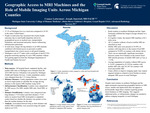
Rural counties in northern Michigan and the Upper Peninsula exhibited the longest average driving distance to a fixed MRI. Mobile MRI units were present in 56.09% of counties with long drives to the nearest fixed MRI versus 50.00% in counties with shorter drives. There was no statistically significant association between county-level distance to the nearest fixed MRI and the presence of mobile MRI units (chi-square test, p=0.58). Counties without MRI access had markedly smaller average populations (14,641) compared with counties served by mobile MRI only (45,218).
Despite rural counties in northern Michigan and the upper peninsula experiencing geographic barriers to MRI access, mobile unit deployment does not appear to preferentially target these counties requiring greater travel distances to MRI imaging. These findings highlight a potential mismatch between geographic need and mobile MRI deployment, highlighting the need for data-driven strategies to improve imaging equity in rural communities.
Publication Date
5-8-2026
Disciplines
Other Medical Specialties
Recommended Citation
Latterman C, Junewick J. Geographic access to MRI machines and the role of mobile imaging units across Michigan counties. Presented at: Research Day Corewell Health West; 2026 May 8; Grand Rapids, MI.
Comments
2026 Research Day Corewell Health West, Grand Rapids, MI, May 8, 2026. Abstract 1870