


Comparison of Thumb Metacarpophalangeal Joint Arthrodesis Techniques by Outcome: A Systematic Review
Files
Download Full Text (220 KB)
Description
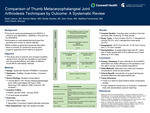
The ultimate role of the thumb metacarpophalangeal joint (MCPJ) is grip stabilization and instability can be debilitating1. Arthrodesis is a well-established surgical technique sacrificing motion for return of stability2. Multiple arthrodesis techniques are described, however, no consensus among hand surgeons exists for which technique is best3. This study aims to examine available literature from the most recent decade to summarize the documented efficacy and safety of thumb MCPJ arthrodesis methods.
A systematic review was conducted in accordance with Preferred Reporting Items for Systematic Review and Meta-Analysis Protocols (PRISMA-P). Databases searched include Pubmed, Google Scholar, and Cochrane Library using Boolean expression: ("thumb MCPJ" OR "thumb metacarpophalangeal joint") AND (arthrodesis OR fusion) AND (technique* OR method*) AND (outcome* OR compar*), retrieving studies documenting thumb MCPJ arthrodesis technique outcomes. Studies examining outcomes between at least two techniques in adults were included. Excluded studies did not meet these criteria. Primary outcomes (fusion rates), and secondary outcomes (patient-reported and/or functional outcomes), were extracted by two independent reviewers. Articles were evaluated for risk of bias (ROB) using design-appropriate assessment tools; those demonstrating high ROB were excluded.
The primary search yielded 15 studies. After exclusion criteria and ROB assessment, 9 were included in the final synthesis of results. Of these, 2 studies were retrospective cohort studies, 2 were retrospective case series, and 5 were retrospective chart reviews. Most were conducted in the United States [n=5, 55.5%], France [n=3, 33.3%], and Canada [n=1, 11.1%]. The average sample size was 54.6 patients, average follow-up duration was 45.3 days, and typical patient age was 55.1 years. Heterogeneity in outcome measures precluded meta-analysis. However, 3 studies found K-wire arthrodesis consistently safe and effective. Tension band wiring had greater numbers of hardware complications in 2 articles with one article citing higher union rates compared to screw fixation. Open arthrodesis techniques remain more reliable than minimally invasive in one study, and union rates may benefit from autologous bone grafting in another. Plate and screw technique may provide excellent alignment but less consistent union rates.
K-wire methods for thumb MCP arthrodesis are widely efficacious and low risk across patient populations and indications. Other techniques lack consistency in terms of union and hardware complications. Further research is needed to directly assess each technique and compare outcomes across arthrodesis methods.
Publication Date
5-8-2026
Disciplines
Plastic Surgery
Recommended Citation
Carson N, Swetha R, Weber R, Girian S, Fahrenkopf M. Comparison of thumb metacarpophalangeal joint arthrodesis techniques by outcome: A systematic review. Presented at: Research Day Corewell Health West; 2026 May 8; Grand Rapids, MI.
Comments
2026 Research Day Corewell Health West, Grand Rapids, MI, May 8, 2026. Abstract 2105